THE END OF MEDICARE? YOU BET AND THIS IS JUST THE START OF THE LACK OF PRIMARY CARE AND SPECIALIST DOCTORS WHO WILL NOT ACCEPT PATIENTS


There are always consequences to every act, and when doctors are told that the amount that they get paid to treat a medicare patient will be cut another 20% of so for 2010, they stop accepting medicare covered patients.

Imagine that your employer told you that this year your salary will be cut 20%, and that these cuts are on top of prior year cuts, and that they will likely continue each year!

Well that is the Medicare program, and how it pays your doctor. If you have a special condition, and its diagnosis and treatment may require a "specialist" you may be totally out of luck, since the additional specialized treatments and the added medical training that it took to be able to provide it do not provide any incentive for that specialist to work for fees that often do not cover even basic time expended with the patient.

Doctors are opting out of Medicare at alarming rates, frustrated by reimbursement cuts they say make participation in government-funded care of seniors unaffordable.

Two years after a Texas survey found nearly half of Texas doctors weren't taking some new Medicare patients, new data shows 100 to 200 a year are now ending all involvement with the program. Before 2007, the number of doctors opting out averaged less than a handful a year.

“This new data shows the Medicare system is beginning to implode,” said Dr. Susan Bailey, president of the Texas Medical Association. “If Congress doesn't fix Medicare soon, there will be more and more doctors dropping out and Congress' promise to provide medical care to seniors will be broken.”

More than 300 doctors have dropped the program in the last two years, including 50 in the first three months of 2010, according to data compiled by the Houston Chronicle. Texas Medical Association officials, who conducted the 2008 survey, said the numbers far exceeded their assumptions.

The largest number of doctors opting out comes from primary care, a field already short of practitioners nationally and especially in Texas. Psychiatrists also make up a large share of the pie, causing one Texas leader to say, “God forbid that a senior has dementia.”

The opt-outs follow years of declining Medicare reimbursement that culminated in a looming 21 percent cut in 2010. Congress has voted three times to postpone the cut, which was originally to take effect Jan. 1. It is now set to take effect June 1.
Not cost-effective

The uncertainty proved too much for Dr. Guy Culpepper, a Dallas-area family practice doctor who says he wrestled with his decision for years before opting out in March. It was, he said, the only way “he could stop getting bullied and take control of his practice.”

“You do Medicare for God and country because you lose money on it,” said Culpepper, a graduate of the University of Texas Medical School at Houston. “The only way to provide cost-effective care is outside the Medicare system, a system without constant paperwork and headaches and inadequate reimbursement.”

Ending Medicare participation is just one consequence of the system's funding problems. In a new Texas Medical Association survey, opting out was one of the least common options doctors have taken or are planning as a result of declining Medicare funding — behind increasing fees, reducing staff wages and benefits, reducing charity care and not accepting new Medicare patients.

In 2008, 42 percent of Texas doctors participating in the survey said they were no longer accepting all new Medicare patients. Among primary-care doctors, the percentage was 62 percent.

The impact on doctors has not been lost on their patients. Kathy Sweeney, a Houston retiree, twice has been turned away by specialists because they weren't accepting new Medicare patients. She worries her doctors might have to drop her if Medicare cuts go through and they can't afford to continue in the program.

“I've talked to them about the possibility,” said Sweeney, who sent her legislators a letter calling on them to fix Medicare. “They're hanging in there as long as there's not a severe cut, but just thinking I couldn't continue doctor-patient relationships I built up over years is disturbing. Seniors should be able to see the doctors they want.”

The problem dates back to 1997, when Congress passed a balanced budget law that included a Medicare payment formula aimed at reining in spending. The formula, which assumed low growth rates, called for payment cuts if spending exceeded goals, a scenario that occurred year after year as health care costs grew. The scheduled cuts, expected to be modest, turned out to be large.

Congress would overturn the cuts, but their short-term fixes didn't keep up with inflation. The Texas Medical Association says the cumulative effect since 2001 already amounts to an inflation-adjusted cut of 20.9 percent. In 2001, doctors receiving a $1,000 Medicare payment made roughly $410, after taking out operating expenses. In 2010, they'll net $290. If the scheduled 21.2 percent cut goes through, they'd net $72, effectively an 83 percent cut since 2001.

The issue caused the Texas Medical Association to break ranks with the American Medical Association and oppose health care reform efforts throughout 2009. Then TMA President Dr. William Fleming said “reform is doomed to failure” without Medicare reform and called Congress' failure to devise a rational payment plan “an insult to seniors, people with disabilities and military families.”
No surprise to senator

U.S. Sen. John Cornyn, R-Texas, said he isn't surprised by the new opt-out numbers, allowing that Congress' inability to reform Medicare is leaving “seniors without access and breaking the promise we made to them.”

“The problem has been how to eliminate the cuts without running up the deficit,” said Cornyn, responding to blame U.S. Rep. Gene Green, D-Houston, placed on the Senate for not passing a House bill that would have provided a longer-term Medicare fix. “There hasn't been the political will, but we really have no choice but to fix it.”

Cornyn acknowledged the task is daunting. The Congressional Budget Office recently estimated that eliminating scheduled Medicare payment cuts through 2020 would cost $276 billion.

The growth in Texas Medicare opt-outs began in earnest in 2007, when 70 doctors notified Trailblazer Health Enterprises, the state's Medicare carrier, they would no longer participate, up from seven in 2006. The numbers jumped to 151 in 2008, fell back to 135 in 2009 and are on pace for 200 in 2010. From 1998 to 2002, by contrast, no more than three a year opted out.

Now, according to a Texas Medical Association new poll, more than four in 10 doctors are considering the move.

“I've been in practice 24 years, and a lot of my patients got old right along with me,” Culpepper said. “It's stressful to tell them you're leaving Medicare and they're responsible for payments if they want to stay with you. You feel like you're abandoning them.”

That is just the start to the destruction of the American medical system that was able to provide some of the best care, the best drugs to prolong life without the misery that accompanies long term pain associated with many conditions related to old age.

Furthermore, emergency rooms will be overwhelmed with every type of patient insured and uninsured. The mandate to have to provide care is killing hospitals as they in effect are forced to provide care to those showing up.

The new health care law will pack 32 million newly insured people into emergency rooms already crammed beyond capacity, according to experts on health care facilities.

A chief aim of the new health care law was to take the pressure off emergency rooms by mandating that people either have insurance coverage. The idea was that if people have insurance, they will go to a doctor rather than putting off care until they faced an emergency.

People who build hospitals, however, say newly insured people will still go to emergency rooms for primary care because they don’t have a doctor.

“Everybody expected that one of the initial impacts of reform would be less pressure on emergency departments; it’s going to be exactly the opposite over the next four to eight years,” said Rich Dallam, a healthcare partner at the architectural firm NBBJ, which designs healthcare facilities.

“We don’t have the primary care infrastructure in place in America to cover the need. Our clients are looking at and preparing for more emergency department volume, not less,” he said.

Some Democrats agree with this assessment.

Rep. Jim McDermott (D-Wash.) suspects the fallout that occurred in Massachusetts’ emergency rooms could happen nationwide after health reform kicks in.

Massachusetts in 2006 created near-universal coverage for residents, which was supposed to ease the traffic in hospital emergency rooms.

But a recent poll by the American College of Emergency Physicians found that nearly two-thirds of the state’s residents say emergency department wait times have either increased or remained the same.

A February 2010 report by The Council of State Governments found that wait times had not abated since the law took effect.

“That is not an unrealistic question about what’s going to happen in the next four years as you bring all these people on; who are they going to see?” McDermott said.

The Washington congressman tried to include a provision in the health care bill he thought would increase the number of doctors.

McDermott’s legislation would have required the government to pay for students’ medical education in return for students serving four years as a primary care physician. The measure did not make it on the final bill that eventually became law.

McDermott stressed that creating a “whole new cadre of doctors” needs to begin now to meet the rising need from patients in the future.

While the measure wouldn’t prevent the infrastructure crunch, it would have provided new doctors for people seeking care.

Richard Foster, Chief Actuary at the Centers for Medicare and Medicaid Services, told The Hill that the current dearth of primary care physicians could lead to greater stress on hospital emergency rooms.

“The supply of doctors can’t be increased very quickly – there’s a time lag,” he said, adding, “Is the last resort to newly covered people the emergency room? I would say that is a possibility, but I wouldn’t say anybody has a very good handle on exactly how much of an infrastructure problem there will be or exactly how it might work out.”

The Academy of Architecture for Health predicts hospitals will need at least $2 trillion over the next 20 years to meet the coming demand.

“As more people have access, you have to deal with the increased capacity,” said Andrew Goldberg, senior director of federal relations at the American Institute of Architects. “At the moment there is not a lot of building going on because of the economy and a lot of health care facilities can’t get the financing. We’ve been working on the Hill to try to address that issue.”

The group has called on Congress to beef-up bonding authorities and expand energy efficient tax breaks for professional buildings. The vehicle targeted is the green energy legislation making its way through the House Ways and Means Committee and Senate Finance.

Dan Noble, a principal at the Dallas-based architecture firm HKS Inc., which also specializes in designing health care facilities, believes the only remedy to meet the coming demand on hospitals is to start projects immediately.

“We would have to get very busy soon,” he said. “It would take a fairly aggressive building campaign for the next decade.”

Of sure..dream on.

GOVERNMENT NON-PERFORMANCE AS USUAL IN THE GULF CRUDE OIL CATASTROPHE; LET'S PASS THE BLAME ON EVERYBODY ELSE!


As we are now expecting, anything that the government is responsible for is usually something we can not count on and is probably just a waste of money. We were proven right again in the GULF oil catastrophe.

Long, long ago after previous disasters various government agencies were mandated to be the FIRST RESPONDERS on such an event and that they were to have FIRE BOOMS instantly available...that was a LAW. Instead, there were no fire booms to use.

The fire booms are special means to gather the oil and to burn it. There were none, they had to find some company in Illinois that had one, yet there is an entire group of bureaucrats that have offices, budgets, limos to ride around in probably, assistant directors, and such and yet they have no booms!

So again the government has failed in its responsibility ( just go visit New Orleans to see the abandoned homes).

Shame on you passing around the incompetence and responsibility.

SMALL BUSINESS LENDING-WHAT SMALL BUSINESS LENDING??? NO LENDING IS GOING ON TO SMALL BUSINESSES-IT'S A CREDIT DESERT OUT THERE!


The headlines purporting to see the light at the end of the tunnel relating to business picking up is a very dull and fading light. The stock market DOW INDUSTRIAL AVERAGE has shown signs of life and was spirited up over the last few months, but you have to remember that there are only 30 STOCKS!

These 30 companies, although representing a cross section of industrial giants are typically not the victims of the current lender's "loan desert" afflicting small business. Small business is defined as having variously less than 500, less than 100 or so employees, and is represented as responsible for most of new hiring and employs most Americans.

The banks receiving TARP funds were told to make loans to "small businesses" yet to date that has not really happened and causing many short of needed working capital to just close up or significantly cut back operations.

Small business is just considered too risky for lenders who are more worried about their derivative trading or counter-party losses, and to lend to a entrepreneur seems risky at best.

Typically small business lending consists of having collateral backing the loans as well as the personal guarantee of the principal owners or stockholders, and as there are less assets to pledge as collateral for loans, there is less lending! The vicious circle is ongoing.

We are seeing marginal businesses simply getting their credit lines canceled, and then all they can do is pay down the existing loans and just close or work on its own cash or credit cards of the owners, etc..

Do not believe the headlines, small business lending is constricted and indirectly what happens to larger business is that it benefits from the demise if is many smaller competitors who are now closing shop.

So the revenue pie may stay the same, but there are less businesses sharing it and thus the small ones close and the big one's grow; like the DOW AVERAGE members.

Is this good for the country? No. Everyone can not work for the giants, there is still a need for the small machine shop, for the boutique design firm, the small specialty chain store or local food store located in "food deserts" as we see the articles.

Hardest hit are businesses in traditionally low margin industries such as small manufacturing, retail and contracting, and the unemployment numbers show it.

Now, add to these credit issues the overhang of the various proposed mandates such as health care to be provided, as well as the numerous others that each state and federal government is calling for, and it can not be predicted to be good for the future growth of the economy.

Small business needs real lending, and most of all a government that understands lending to small business and supports the lenders who do such lending.

CLUELESS-NO IT IS NOT THE NAME OF A MOVIE ABOUT AN AIRHEAD BLONDE, BUT A DESCRIPTION OF OUR CONGRESSIONAL MAJORITY


How would you feel about this scenario if you heard it.

Let's say that your neighbor or best friend is spending more money than he earns, and then he told you that he is asking all his banks to lend him more money, asking his credit card providers to lend him more money, and that as far as he can predict he will not make sufficient income to ever pay back any of these loans!

In fact he expects to be spending $1 TRILLION ( that's a thousand billion!) more than he earns every year for as many years as he can predict and he is taking on more and more loans and obligations that are bound to increase this total.

What would you say to this person?

Well friends, this is our government at work, and we are the hapless neighbor standing there watching the self destruction of this person...except that it is not a person it is our COUNTRY!

Since about 20% of all Americans are functionally illiterate, according to statistics provided by the Department of Education, they have no idea about any of this. Another 25% depend on some program or handout from a government so that they support all government spending in the hope that some of it will end up in their pocket, we can assume that 55% of Americans are clueless or in favor of these policies!

This is a road of no return that will destroy the value of our currency, the value of our savings, as well as significantly diminishing our standard of living.

The runaway spending is unprecedented, it will be the destruction of America just as it destroyed the Roman Empire...exactly for the same reasons in 400 AD, and the Weimar Republic in the early 20th Century.

STUPID IS AS STUPID DOES: THE EUROPEAN UNION'S RESCUE PLAN FOR THE "PIGS"...BUT PIGS ARE ALWAYS PIGS! THE PROBLEM IS JUST DELAYED


Last week the US stock markets did a rubber-band swing in the time of just several minutes, with certain high value stocks declining to near zero others declining by significant percentages. Various reasons were provided by pundits ranging from "my dog entered a sell order by mistake" to "there was fear of the Greek tragedy." Right, sure, and if you believe that I have a bridge in Brooklyn you might want to buy!

Now today, the market was up about 400 points with the excuse that the investors liked the $1 trillion "rescue package for the weakest links in the EURO zone, the so called PIGS, (Portugal, Italy, Greece and Spain.) Pigs is certainly a good name for those countries in describing their socialist welfare states that are literally running out of other people's money to pay people who are not working, are overpaid in their retirement pensions, are sucking off the state in every conceivable freebie possible, until the well dried out!

Yes as we all should note, there is only so much water in the well. Eventually all wells dry out! Theirs is near that point and these are the weakest links in that EURO zone, they will dry out the $1 trillion well.

The EU was a good idea in theory, but trying to have so many countries acting as one, so many cultures acting as one, is near impossible and has never previously succeeded and here simply is why not.

Let's say that my country, a hypothetical country in the EURO zone, our parliament decides to give every retiree a lifetime pension of $100,000 a year. Then as the country runs out of money, they get a "loan" to tide them over that crisis. Then the next country seeing how well that worked out, does the same, the next does the same....see how that works? It does not work, but in effect that is what has just happened.

The out of control social programs in these countries will drive them to insolvency, just like our new entitlements will as well.

Our budget deficit will create unbearable debt, and there is no end in sight.

All these countries have "stupid" onerous employer mandates requiring costly payments into social welfare programs or the employer needs to provide a safety net and comfort net that become costly and thus employment decreases.

For instance a great example is the 4-8 weeks of vacation that are routinely allowed and paid for in the EU countries, thus reducing productivity significantly.

I remember last year in dealing with a French company in July...forget it, nobody was working at all, everyone was on vacation! No work got done until the managing director and most employees came back in September.

The other problem is that most EU politicians are no different that ours, they almost never had a real job in the workforce, or ran a business and thus have no idea how the real economic forces work. In order to raise money, they raise taxes, until there is nothing left and the underground economy operates, you guessed it, under ground, not taxed, or reported.

All business stagnates under a high tax system. Businesses do not grow, and new employees are not hired.

Another report came out last week finding that when Congress extended the unemployment benefits, those out of work failed to "find" jobs longer, thus prolonging both that as well as adding to the national deficit to finance those benefits to be paid.

This is only normal human nature, if you get something for nothing, why not take it!

With now almost 50% of the population not paying any taxes, the other 50% is trying to find ways not to pay as well, so this circle of deceit will get to be quite interesting.

Bailouts, temporary loans, rescue packages...none of these address the problem of out of control spending by every government and their ability to borrow or to get "rescued" just prolongs, but never solves the problem.

As Greece goes, so will the rest of the EU zone.

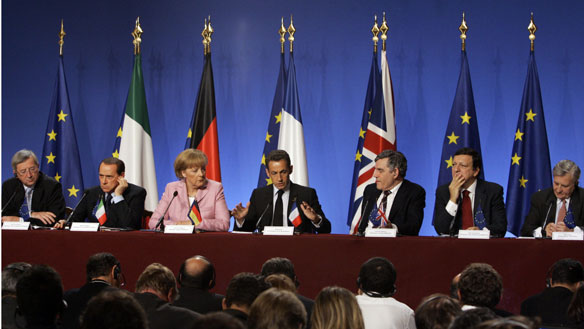
European leaders orchestrated a huge show of financial force to halt a spreading debt crisis, drawing applause from investors but also questions about whether the nearly $1 trillion rescue package merely postponed a reckoning with the euro area’s underlying problems.

Jean-Claude Trichet, president of the European Central Bank, spoke to reporters Monday, following a two-day meeting of central bankers.

Markets rallied around the world (FOR ONE DAY) in response to the extraordinary show of solidarity in defending the euro, which topped even the U.S. government’s support for its collapsing financial system in 2008. A broad index of European blue chips closed up more than 10 percent and Wall Street was up more than 3 percent in afternoon trading.

The risk premium on Greek bonds nearly halved as the European Central Bank said it would buy government bonds directly for the first time ever.

But analysts pointed out that the package did nothing to reduce overall debt — it just spread it onto more shoulders. HA HA, as that Simpson's character would say riding on his bicycle.

There will also be a risk that, by in effect shielding Greece, Portugal, Spain and other over-indebted countries from the harsh verdict of the open market, the measures will make it harder for political leaders to overcome public resistance to the deep budget cuts needed to get spending and borrowing under control. Strikes in Greece led to a riot last week that left three people dead.

In what could be a sign of continued jitters, the euro gave up much of its early gains on Monday and interbank lending rates remained elevated. Moody’s Investors Service also announced that it might cut Greece’s credit rating to junk within the next month, citing the country’s “dismal” economic prospects.

“Lending more money to already over-borrowed governments does not solve their problems,” Carl Weinberg, chief economist of High Frequency Economics in Valhalla, New York, said in a research note. “Had we any Greek bonds in our portfolio, we would not feel rescued this morning.”

Robert Barrie, head of European economics at Credit Suisse, paraphrased Winston Churchill: “It’s not the end, I’m not even sure it’s the beginning of the end.” But, he added, “it takes us away from the threat of a crisis.”

Jean-Claude Trichet, president of the E.C.B., said the central bank’s governing council decided to prop up the bond market and inject cash into the European banking system because “the channels of normal monetary policy were not functioning.” Only four days earlier, Mr. Trichet had insisted that the council had not even discussed bond purchases.

The E.C.B. action Monday also included measures, together with the U.S. Federal Reserve and other major central banks, to provide banks with dollars through the use of currency swaps.

The swaps are intended to make it easier for European companies, institutions and governments to borrow dollars when they need them, “and to prevent the spread of strains to other markets and financial centers,” the Fed said in a statement from Washington.

The scale of the E.U. rescue program — €750 billion, or $957 billion — recalled the $700 billion package the U.S. government provided to help its ailing financial institutions in late 2008. That package, known as the Troubled Asset Relief Program, or TARP, also cheered markets at the time, but the uplift proved temporary until much later, after the broader economy, and U.S. banks, began to recover.

The E.U. package, reached after hours of meetings that lasted until early Monday, includes €440 billion in loan guarantees and €60 billion under an existing lending program. Elena Salgado, the Spanish finance minister who announced the deal, also said that the International Monetary Fund was prepared to provide up to €250 billion separately.

One major difference between the European bailout and the TARP plan, however, is that Europe is hoping that the fund will not be activated. After the Lehman collapse, there was always a certainty that the TARP would be deployed as soon as it was approved by the U.S. Congress.

Indeed, for all the excitement about the numbers, it is important to remember that the headline €440 billion number does not now exist. It is a commitment by E.U. governments to borrow such an amount if a large economy like Spain, which represents 12 percent of euro-zone gross domestic product, asks for it — and then have the I.M.F. contribute about half of what Europe lends.

By definition, if it came to such a point, interest rates would climb and the billions of euros that the special purpose vehicle would have to raise from the markets would not only come at a high cost, but would increase the debt levels of the likes of Portugal, France, Italy and Britain, thus compounding the region’s heavy debt woes.

In the months ahead, investors are likely to closely scrutinize monthly budget figures from European governments, which previously went almost unnoticed.

“You definitely would want to see these additional austerity measures, especially Spain and Portugal,” said Elga Bartsch, an economist at Morgan Stanley in London. “They all seem to be moving and getting more serious in addressing the underlying problem.” SURE THEY WILL DO THAT!

On Monday, Mr. Trichet warned European governments, all of whom are likely to miss the budget deficit targets they agreed to when they formed the euro, that they must continue to cut government spending.

“For us what is absolutely decisive is the commitment of governments of the euro area to take all measures needed to meet their fiscal targets this year and in the years ahead,” Mr. Trichet said at a press conference in Basel, Switzerland.

He declined to say how much money the bank would spend buying government bonds on open markets, via the euro-zone’s national central banks — a process that began Monday.

The E.C.B. also said that it would resume offering unlimited cash for up to six months at the benchmark interest rate of 1 percent for banks that post the necessary collateral.

The Bank of Japan joined in the global response, saying after an emergency board meeting Monday that it would pump ¥2 trillion, or $21.6 billion, into financial markets for a second consecutive trading day.

The overall package was much larger than expected, and represented an audacious step for a bloc that had been criticized for acting tentatively, and without unity, in the face of a mounting crisis.

At the same time, the sheer size of the package will strain the unity of Europe’s fractious governments, especially when leaders like Nicolas Sarkozy of France or Angela Merkel of Germany are losing ground politically. Ms. Merkel’s Christian Democrats lost power in North Rhine-Westphalia, Germany’s most populous state, in elections Sunday.

In effect, Germany and other wealthier European countries are assuming responsibility for the creditworthiness of Greece, Portugal and the other debt delinquents, as if the U.S. government were bailing out California.

But the European central government is weak and must invent new structures to administer the promised aid.

“The debt crisis will change the nature of European monetary union,” Jörg Krämer, chief economist at Commerzbank, argued in a note Monday. “The euro zone has moved away from a monetary union and towards a transfer union.”

Mr. Krämer warned that the shift “can undermine political support for the euro zone in the long run. After all, it is unlikely that the countries receiving support will let others permanently dictate their economic policies. Moreover, voters in the countries giving support will not be willing to permanently give financial support to other countries.”

So the game of charades continues....fooling nobody.

COMPUTERS CONTROL THE VALUE OF ALL STOCKS, YOU MAY NOT REALIZE IT BUT IT CAN HAPPEN AT ANY MOMENT AND CAN NOT BE STOPPED!


Trades on the trading floor of the NYSE turned to their screens and many were just frozen not believing what they saw. Excelon, the gigantic Illinois utility holding company was at near ZERO stock price trading at 41 cents down from $41 dollars! It was showing a 99% price drop. Worse yet, BOSTON Beer (maker of the Samuel Adams beers) which traded at about $48 a share, was down to ZERO!!!!

Probably when they saw BEER at zero, they realized that it was impossible, and then started to realize something was wrong.

Many other top stocks were acting similarly so traders did not know what to do, buy, sell, wait, hold...total pandemonium ruled.

Expect that the administration, composed of 95% of people who had no real job, to want more "controls" again.

Dow stocks plunged 9 percent in the last two hours of trading before
clawing back some of the losses. Nasdaq OMX said it would cancel
trades with price deviations of more than 60 percent between 2:40 p.m. and 3
p.m. from their 2:40 p.m. levels, and the New York Stock Exchange said it would
similarly cancel trades on its all-electronic NYSE Arca platform that deviated
over 60 percent from their last print at 2:40 p.m. between 2:40 and 3 p.m.

Some stocks dropped to nearly zero before rebounding. The following is a
list of some of the biggest drops, as well as some large cap companies that had
significant drops.
COMPANY PREVIOUS PRICE LOW PRICE PCT CHANGE
EXCELON $34.68 $0.41 -99
BOSTON BEER $47.98 $0 -100
CENTERPOINT $13.13 $0.01 -99.9
BROWN & BROWN $15.93 $8.04 -49.5
IOWA TELECOMMUNICATIONS
SERVICES $15.67 $2.66 -83
CASEY'S GENERAL $35.00 $30.24 -13.6
EBIX INC $14.26 $1.01 -92.9
PROCTER & GAMBLE $59.41 $39.37 -33.7
APPLE $240.63 $199.25 -14.4
3M $81.86 $67.98 -17

AMERICA IS REALLY JUST LIKE GREECE EXCEPT IT IS 30 TIMES LARGER IN POPULATION AND ITS STAGGERING NON-REPORTED DEBTS OF $112 TRILLION!


"Greece is not America", I saw a public official's quote in the paper. But that quote is deceptive since it is totally FALSE. Everything about the USA's publicly reported debt is wrong, and the quote should be," America is way worse than Greece!".

Scary thought, is it not?

All over the country, individual state governments are finding that the lower revenues must also temper spending. The legislators are unable or unwilling to do so, so that now, by default, they are announcing teacher layoffs for instance. In Illinois, teachers took a day off teaching and assembled in the State Capital to yell,"RAISE MY TAXES", ( meaning raise MY taxes).

The impression is that teachers are just so underpaid, so being at the front lines like this serves to create the impression that these poor teachers are just so worthy of getting a raise.

The reality with teachers in Illinois, as elsewhere, is just the opposite of the impression created by the media and teacher unions. The web site-www.the champion.org, provides all the teacher salaries (salaries only, no accounting for the generous pensions) which is absolutely astounding.

For instance, due to seniority and teacher contracts which have never been reigned in, the two highest paid teachers in Illinois, in one of the WORST performing school districts-CHICAGO, their salary is---HOLD ON TO YOUR WALLET, IN EXCESS OF $600,000 ANNUALLY!!!!!! Plenty more teachers make in excess of $200,000 and $300,000 as well! Keep in mind that teachers work only about 180 days a year, not like the rest of us, who work with an average of 2 weeks vacation and thus about 250-300 days a year.

We will be looking like Greece in this generation as our debt mushrooms out of control and "reality hits" the federal and state budgets, the dollar value declines and savings and investments are wiped out.

In Greece, there are only about 10 million people, we have 30 times more. Our problems are going to be 30 times more!

Greek government workers shut down schools and hospitals and disrupted flights as demonstrators occupied the Acropolis in an escalation of protests against 30 billion euros ($40 billion) of additional wage cuts and tax increases unveiled this week.

The ADEDY union federation, which represents more than 500,000 civil servants having their pensions and pay slashed under measures announced May 2 by Prime Minister George Papandreou, will hold a rally at midday joined by striking teachers. A general strike, the third this year, is planned for tomorrow, with private-sector workers due to participate.

“Protests will increase,” said Spyros Papaspyros, the head of ADEDY. “Opting for the easy path of cutting wages and pensions can’t be accepted.”

Papandreou has called on Greeks to endure more sacrifices in return for an unprecedented 110 billion-euro bailout from the European Union and the International Monetary Fund. The austerity measures, called “savage” by union groups, include a second set of wage cuts for public workers, a three-year freeze on pensions and a second increase this year in sales taxes and the price of fuel, alcohol and tobacco.

Protesters from the Communist Party of Greece draped banners over the walls of the ancient Acropolis citadel in Athens today that said “Peoples of Europe Rise Up” in Greek and English, as tourists took photographs. Unemployed teachers yesterday disrupted the evening news show on state-run NET TV.

‘Terrorizing’ Tourists

Government spokesman George Petalotis condemned the occupation of the Acropolis, saying on NET TV that such protests “aimed to destroy tourism to Greece by terrorizing foreign visitors.”

“My trip is complete,” said Roger Smith from the U.S. as he took photos of the protests below the Acropolis. Smith, on his first visit to Greece with his wife, Diane, said rich Greeks, like rich Americans, needed to pay their taxes.

Elected in October on pledges to raise wages for public workers and step up stimulus spending, Papandreou revised up the 2009 budget deficit to more than 12 percent of gross domestic product, four times the EU limit, and twice the previous government’s estimate. EU officials revised the deficit further on April 22, to 13.6 percent of GDP.

Investor Concern

The surge in the budget gap as the economy contracted fueled investor concern about Greece’s ability to finance the deficit and sent borrowing costs to the highest since before the start of the euro in 1999. Papandreou has pledged to cut the shortfall to within the EU limit of 3 percent in 2014.

Fifty-one percent of Greeks say they won’t accept new austerity measures and would join protests against them, according to a poll of 1,000 people by ALCO for Proto Thema newspaper. That compared with 33 percent who would accept them. No margin of error was given for the poll, which was conducted from April 27 to April 29.

Most Greeks feel anger and dismay rather than relief over Papandreou’s decision to request emergency loans, a separate survey showed. Just 14.8 percent of the 1,256 people polled by Kappa Research April 28-29 for To Vima newspaper felt relief or hope after the move, compared with 31 percent who answered “anger,” 30.6 percent “disappointment or fear” and 22.8 percent who said they felt “shame.” The margin of error for the poll was 2.6 percentage points.

Aid Package

Greeks were divided on whether Papandreou needed to ask for the aid package with just over 50 percent saying it was necessary and 41.9 percent saying it could have been avoided, according to the Kappa poll.

With cuts in wages and increases in taxes, the Greek economy is forecast to shrink 4 percent this year and 2.6 percent in 2011. Unemployment has risen to 11.3 percent, a six- year high.

Archbishop of Athens and All Greece, Hieronymos, the leader of the Greek Orthodox Church, said the Church, which represents most of the 11 million Greeks, would stand by the “battered Greek people” and urged “unity, strength and optimism,” according to the state-run Athens News Agency.

Finance Minister George Papaconstantinou said the government plans to submit legislation on the latest budget cuts to parliament today. Papandreou has a 10-seat majority in parliament, enabling the government to push through the measures.

Electricity Company

Tomorrow’s general strike could disrupt public transport, air traffic, ferry sailings and other services as workers from shopkeepers to sportswriters walk off the job. Employees at Public Power Corp SA, the state-controlled electricity company, also will strike.

An air-traffic controllers’ strike will mean all flights at the Athens International Airport, the country’s biggest, will be cancelled. Greek carriers Aegean Airlines SA, which cancelled 17 flights for today, and Olympic Airlines SA won’t operate any flights tomorrow.

The government also promised changes to the pension system, such as raising the retirement age for women in the public sector, increasing the number of years worked before qualifying for a pension and overhauling labor rules to make firing workers easier and cheaper. Labor Minister Andreas Loverdos plans a press conference on the measures today.

Some economists say the worst is yet to come. Paul Mylonas, chief economist at National Bank of Greece, anticipates social unrest “will be muted this year” and could grow as the austerity measures continue into the coming years.

“The risk is more for ‘adjustment fatigue’ going down the road,” Mylonas said. “There’s a higher risk of social opposition for further reforms in 2011 and 2012 if light doesn’t begin to appear at the end of the tunnel.”

In the United States virtually every public sector entity utilizes multiple “sets of books” to account for debt, deficits, and unfunded liabilities of welfare programs and the costs of their own employee benefits. In some cases, most notably concerning health insurance continuation coverage, there is virtually no unfunded liability disclosed to taxpayers. The federal government does not include the unfunded liabilities of Medicare, Social Security, or its own retirement programs as part of the official US debt.

All federal and most non-federal public sector entities also pay higher salaries and offer better benefits to their employees than can be provided in the private sector. The massive cost of early retirement for public sector employees, available 10-25 years earlier than is allowed by Social Security, together with free or highly subsidized health insurance during the early retirement years, is generally hidden from taxpayers. Virtually every government entity has huge understated and underfunded liabilities that are either not represented at all, or are misrepresented to taxpayers via employing misleading or incomplete actuarial and accounting methods that the government itself will not tolerate of the private sector.

A report prepared for FEN by Andrew Biggs, a scholar from the American Enterprise Institute, states that the disclosed “debt” of non-federal entities is approximately $2.2 trillion (the sum total of all bonds), and that the additional “off the balance sheet” unfunded liability for non-federal public sector pension plans is currently stated to be around $400 billion.

Biggs concluded that the actual unfunded liability for these public sector pension plans would be $3.5 trillion if more realistic and conservative interest rate assumptions were utilized. Attempts by others to determine the true federal debt (including unfunded obligations) result in the determination that if one federal “balance sheet” were utilized, the total federal debt would exceed $107 trillion, not the $12.3 trillion currently stated as “debt”. The result is that the total federal and non-federal debt (if unfunded liabilities are included) is an estimated $112+ trillion, or SEVEN TIMES higher than the total $15 trillion currently disclosed to taxpayers.!!

Lies and tricky accounting that would get any CFO into prison, are just normal for our government entities.

DODD IS A DUD AGAIN-FAILED SENATOR RESPONSIBLE FOR COLLAPSING THE MORTGAGE MARKET NOW PROPOSES COUNTLESS NEW BUREAUCRACIES TO POLICE THE MARKETS


Banks and securities firms were collapsing, the mortgage market disintegrating, Wall Street itself was on the rocks, people were losing their life savings, homes and cars, while their credit lines were being cut off for no particularly good reason.

While this was going on, dozens of "senior" SEC staffers were surfing a variety of porn sites as much as 8 hours a day! This excluded the surfing time on taxpayer time and dollars of Elliot Spitzer, Bill Clinton and Barney Frank.

Now, that aging and thankfully retiring genius, who was responsible for the mortgage collapse, Senator Chris Dodd, who also forgot he got a sweetheart mortgage deal from a failed mortgage provider, has been looking to force on the market another Federal monstrosity with no less than 12-14 new departments and bureaucracies to over see the financial markets and firms!

It was Dodd, and his look alike, Barney Frank ( the voice of Yosemite Sam in the cartoons), who fought every attempt to stop the failed policies of FANNY and FREDDIE who they defended their reckless policies and paid millions to their appointed Democrat leaders.

We already have so many overlapping government policing bodies for the securities industry, that I bet Mr. Dodd could not even name several, and he is the chairman of a Senate committee overseeing all types of financial markets. Thankfully he is being chased out of the Senate before the ray of light is shined on his illustrious career of greed, self dealing and ineptness.

This guy has done more to decrease the value of our homes, screwed up our lending industry and all the while enriching himself.

Now he wants to reform the industry...him reforming the industry? LOL.

Dodd is a dud, finally he is leaving. This guy never had a real job in his life and has lived off the public dole his entire life...thank you for finally quitting and don't let the door hit you on the way out....one down and 59 to go!

Senate Democratic leaders set Monday for a key vote on financial regulatory reform legislation, setting off frantic negotiations to complete a bipartisan deal, while President Obama, speaking in New York, urged Wall Street "to join us, instead of fighting us." Right, join us id further destroying the free markets, free enterprise and add countess needless incompetents federal porn surfers.

The effort to reach a compromise on the landmark bill is expected to stretch through the weekend. Negotiations are focused on easing some of the bill's tough proposals on consumer protection, a fund to handle future financial crises and controls on the complex financial derivatives markets.

It is doubtful that any of the writers of this bill even know what a derivative is!

"We cannot turn into a petulant organization that screams at each other," said Senate Banking Committee Chairman Christopher J. Dodd (D-Conn.). Oh really Senator, what really should be done is your mom needs to put you over her knee and spank you till you can finally see the light.

"We are now confronted with another great challenge — whether or not we can address the kinds of issues that will avoid the next financial crisis," Dodd said. Yes the crisis caused by YOU!

"We're continuing to negotiate in good faith, trying to reach a common goal," said Sen. Richard C. Shelby (R-Ala.), who has been working with Dodd to craft a compromise. "I hope it's a bipartisan bill that we can gather a lot of people on both sides of the aisle.… But what is the main goal? To do it right."

Senator, you need to take your meds, so that you know what you are talking about.

The groundwork for the Senate's first vote on the issue was laid Thursday when Senate Majority Leader Harry Reid (D-Nev.) Who voted against his own Health care bill since he appears to have dementia, asked to bring the legislation up for debate. As expected, Minority Leader Mitch McConnell (R-Ky.) objected, delaying action and giving negotiators more time to reach a compromise. Even if no deal is reached, Reid could win over at least one Republican ( dazed or fooled, confused) to circumvent McConnell's objection with a 60-vote majority in Monday's vote to begin formal debate.

Sen. Charles E. Schumer (D-N.Y.), another genius, said he found it hard to believe that Republicans would "all vote no, blocking financial reform." They would not vote no if this was really reform.

"My guess is they won't," he said. But so far, no Republican has publicly announced support for the bill.

The landmark legislation would tighten financial regulations dramatically, alter free markets and create countless new federally mandated porn surfers, with great pension programs at taxpayer's expense.. It would create an agency to protect consumers in the financial marketplace; impose tough regulations on complex financial derivatives; grant shareholders a nonbinding vote on executive compensation ( wee need to vote on the salaries of the senators as well; and give the government authority to seize ( for any reason, and dismantle large firms whose failure would pose a danger to the economy or to their political agenda, to try to avoid future bailouts.

The financial industry, business groups and many Senate Republicans oppose several provisions, including a requirement that large banks such as Goldman and Bank of America spin off their derivatives-trading operations into subsidiaries. Industry executives argued that this could drive lucrative derivatives business overseas.

Democrats and Republicans also were haggling over how much power states would have to enforce national rules that the new consumer agency would write on financial products.

Another focus of dispute, however, appeared close to being solved. Many Republicans strongly oppose a proposed $50-billion fund to cover the costs if the government has to seize and dismantle a large financial firm on the brink of bankruptcy.

McConnell said having such a fund in place would allow it to be used for future bailouts. Dodd and Obama administration officials have said they are not wedded to the prepaid fund. They prefer that all taxpayers instead fund all the costs.

GREECE FINANCIAL CHAOS IS COMING TO AMERICA SOON; PRELUDE OF WHAT IS TO COME IS CLEARLY DEMONSTRATED BY IRRESPONSIBLE GOVERNMENT SPENDING


Greece at one time ruled the world, for those of us who remember our high school world history class. Now it is a struggling entitlement laden country of 11.5 million people who are on the verge of bankruptcy due to its $400 billion public debt.

If you were to start mathematically calculating the debt that Greece is struggling with, its debt is relatively equal to the US debt, which is 30 times its population size and equal also in dollar terms, about $12 TRILLION.

So what is the difference between Greece and the USA? Well, on a fiscal basis, none, except that the USA is not part of the European Union ( EU) which can dictate fiscal policies to member countries, and therefore has spared the USA of being a fiscal pariah like Greece is now in the EU zone.

There are of course other factors that create the appearance of fiscal strength on the part of the USA, but they are illusions compared to reality and are based solely on the reputation of the USA, rather than actual financial condition differences.

If Greece collapses financially, which it will and must, nobody outside of that country really cares, and some banks and the various other lenders/creditors/bondholders involved will have to write down the value of those holdings, but the rest of the 6 billion people could care less.

Greece suffers from a malady that we in the USA have now been infected with: "entitlements" that will eventually absorb the budget and everyone living here, in the next generation or two. America will be Greece by 2040-2050.

Currency speculators will be betting against the dollar and selling it, while buying the Yuan or the Rupee! The dollar will be just another battered currency and the country will be one slugging along burdened by unsustainable debt, trading at a deep discount to face value, since it will never be able to pay off that debt, therefore technically a bankrupt state, unable to ever pay its obligations.

Recent news releases have stated that about half of the US population pays no income taxes and a great percentage of the non-payers also actually get a REBATE of someone else's taxes instead! " Let' the rich pay," is a common shout---hello.... the top 25% pretty much pay more than 90% of the taxes already should they pay 100% now, to be fair? What happens when there is nobody left to pay?

Never in the history of this great country have the politicians been as ignorant about fiscal policy, fiscal restraint and spending as now, and this spending spree is being funneled by the least informed Congress who does not even read 2,400 page bills that it passes, knowing nothing of its full contents or implications!

Greece was a former world power...a long...log time ago...it's in the history books, and its fall long ago was for the SAME policies as its fall is today!

America is now Greece, and oblivious to the history lessons from its long ago fall as well as its current fiscal destruction.

Advice, buy and hold the Yuan and get a Yuan dominated Visa account at one of the international banks account...it will only gain in value as the dollar must inevitably decline. The unsustainable deficits, new unsustainable entitlement programs and anti-business administration is the beginning of the fiscal destruction of America.

This is the Greek tragedy.

In ATHENS, Greece, civil servants staged a 24-hour strike Thursday against austerity measures and expected job cuts by Greece's crisis-plagued government, and the EU's statistics agency said the country's budget was even worse than previously thought.

The strike disrupted all public services, shut down schools and left state hospitals working with emergency staff. Protesters from a Communist-backed trade union blockaded Athens' main port of Piraeus, disrupting ferry services.

Eurostat, meanwhile raised Greece's budget deficit in 2009 to 13.6 percent of gross domestic product from its earlier prediction of 12.9 percent, while the ratio of government debt to GDP stood at 115.1 percent, the second highest in the European Union after Italy.

In comments that are sure to rattle markets, the statistics agency also expressed "a reservation on the quality of the data reported by Greece." It also said Greek's 2009 figures could be revised further, to the tune of 0.3 to 0.5 percentage points of GDP for the deficit and 5 to 7 percentage points of GDP for the debt.

Markets were shocked last fall when the government announced that the previous conservative Greek government had issued misleading financial data for years.

About 3,000-4,000 protesters marched through central Athens, carrying banners reading "tax the rich" and "Don't take the bread from our table." Scuffles broke out when about 150 demonstrators challenged police lines near the city's central Syntagma Square, and police responded with tear gas.

Greek airports remained open, however, after air traffic controllers suspended their participation in the strike because of the travel chaos caused by Iceland's volcanic ash cloud.

Labor unions fear deeper cuts after the Socialist government began talks this week with the International Monetary Fund, the European Central Bank and the European Commission for a three-year rescue package aimed at easing the country's acute debt crisis.

"The IMF has the same cookie-cutter solution for different economies ... Now they are making a European cookie cutter," said Spyros Papaspyros, head of the civil servants umbrella union, ADEDY.

News of the revised figures sent Greece's borrowing costs shooting up to new record highs. The interest rate gap, or spread, between Greek 10-year bonds and German ones - considered a benchmark of stability - widened to 5.29 percentage points minutes after the announcement, from 5.03 percentage points earlier in the morning. The spreads translate into prohibitively high interest rates of more than 8 percent, more than twice those of Germany's.

Athens said its target of reducing its deficit by at least 4 percentage points in 2010 remained unchanged despite the revision.

"The government has already adopted all the necessary measures in excess of 6 percent of GDP to ensure the achievement of this objective," the Finance Ministry said.

It said the new figures showed the scale of Greece's financial troubles, which it blamed on mishandling by the previous, conservative government.

Greece is struggling to cope with a debt of euro 300 billion ($406 billion) and needs to borrow about euro54 billion this year alone. It has a projected public debt of more than 120 percent of gross domestic product through 2011.

On Tuesday, the government shaved its May borrowing requirement by raising euro95 billion ($2.62 billion) in a 13-week treasury bill auction that was oversubscribed. The public debt management agency said Thursday it had accepted an additional euro450 million in noncompetitive bids for the treasury bill auction, which has a settlement date of April 23.

Comparing the Greek debt to the US, the parallels are almost identical.

EMPTY POCKET SYNDROME: AMERICANS ARE LIVING PAYCHECK TO PAYCHECK; HALF CAN NOT RAISE EVEN $2,000 FOR AN EMERGENCY!


Americans are living paycheck to paycheck according to a recent survey.

Almost half of Americans surveyed recently, said that they were not confident that they could raise $2,000 within a MONTH in a crisis, like having an unexpected medical bill, a furnace repair, an emergency car repair or anything unexpected!

This inability to raise the cash included not being able to have sufficient credit card credit, access to loans from friends and relatives or access to any ability to sell assets to get the funds.

Also, surprisingly, 25% of people surveyed who made between $100,000-$149,000 also admitted that they too, would not be able to raise that same $2,000!

Researchers who evaluate these types of statistics were stunned by the results, since in previous surveys, the question was typically asked on the basis of " do you have $2,000?", rather than can you get access to $2,000....so it is quite revealing that fully 46% of the representative population is living in such a tight financial position.

DESTRUCTION OF AMERICA DUE TO WILD SPENDING SPREE-GOVERNMENT MISINFORMATION CORRECTED TO SHOW TRUE EFFECT OF OUT-OF-CONTROL BUDGET


Reprinted from the HERITAGE FOUNDATION ANALYSIS

The fiscal year mercifully concluded on September 30. Reckless spending by Congress and the President made it a year in which:

* Government spending exceeded $20,000 per household for the first time since World War II,
* The federal budget expanded by $353 billion over its 1998 level,
* Defense and the attacks on September 11, 2001, accounted for less than half of all new spending since 2001,
* Mandatory spending reached its highest level in history, and
* Spending increased despite net interest costs plummeting by $110 billion.1

This paper examines the colossal expansion of the federal government since 1998. That year, a temporary tax revenue boom brought the first budget surplus in over a quarter-century. Abolishing the budget deficit also eliminated one of the most effective arguments for spending restraint, and the spending floodgates swung wide open. By 2001, the budget surplus was quickly evaporating because tax revenues, back to their historical levels, could no longer keep pace with runaway spending. The 9/11 terrorist attacks then necessitated new spending on national security. But by that point fiscal responsibility was a distant memory, and lawmakers steadfastly refused to balance these new high-priority security costs with savings elsewhere in the budget. As 2003 closes, the nation finds itself burdened by runaway federal spending and massive looming structural budget deficits.1

Overall Spending

Federal spending grew by 7.3 percent in 2003, slightly slower than the 7.9 percent growth rate in 2002. The slower growth rate is encouraging; yet, Chart 1 shows that government is still growing significantly faster than it did in the 1990s. In fact, the 7.6 percent average annual growth over the past two years more than doubled the 3.4 percent average annual growth from 1993 to 2001.2

The total amount of federal spending -- $2,156,536,000,000 -- is too large to fully comprehend (in $1 bills, it would stack halfway to the moon, weigh 10 times as much as the Sears Tower, and blanket the state of New Jersey). A more relatable statistic is federal spending per household, which allows families to measure the costs and benefits of government in their own lives. Throughout the 1990s, real federal spending remained slightly under $18,000 per household. From 1998 through 2003, federal spending jumped by $2,500 to reach $20,300 per household -- marking the first time since World War II that federal spending has topped $20,000 per household (see Chart 2 and Table 1).3

For that amount of government, Americans paid $16,780 per household in federal taxes in 2003 -- a staggering tax burden indeed, but only the beginning. Federal revenues are still $3,520 per household less than federal spending. That difference represents the per-household cost of the $374 billion budget deficit. Since all federal spending must eventually be paid for in taxes, the $3,520 per household represents higher future taxes that must be collected to fund the full $20,300 per household that Washington spent in 2003.

The reality that all spending must eventually be paid for in taxes cannot be overemphasized. Despite its current popularity, the "big-government conservative" model of coupling tax relief with rapid spending increases is not sustainable in the long run. If Washington continues to spend $2,500 per household more than it did in the 1990s, then taxes must eventually rise by $2,500 per household per year. Budget deficits can delay, but not ultimately avoid, the tax collector. Permanently higher levels of spending require permanently higher taxes.

Where the Money Went

Table 2 shows that real federal spending surged by $353 billion between 1998 and 2003. Defense and Social Security combined for nearly half of that increase, which is not surprising given their historically large budgets. However, they did not grow as fast as other categories. For example:

* Unemployment Compensation payments jumped 132 percent to $56 billion. Much of this increase was automatically triggered by rising unemployment claims during the 2001-2002 re-cession. Additional spending resulted when Congress and President Bush enacted several bills extending unemployment benefits to workers beyond their typical 13-week limit. (See Chart 3.)


* Education spending surged by 78 percent, from $34 billion to $58 billion. Nearly all of this growth took place between 2001 and 2003, as the No Child Left Behind Act was being implemented. Most of the new spending was for aid to K-12 schools (including special education funding), which jumped from $19 billion to $32 billion. An $8 billion hike in college student financial aid dominated the rest of the spending increase.


* Health Programs (other than Medicare and Medicaid) leaped 81 percent, from $33 billion to $60 billion. The National Institutes of Health's budget, which expanded from $14 billion to $23 billion, was the main contributor. The new State Childrens' Health Insurance Program (S-CHIP) added $4 billion in new annual spending, and other public health programs accounted for the rest of the increase.

* Agriculture spending increased by 76 percent to $23 billion. Farm spending actually peaked at a record $39 billion in 2000 after Congress overreacted to a slight dip in crop prices by passing a series of massive "emergency" payments. The budget-busting 2002 Farm Bill assured that farm subsidies would not drop back to their 1998 level, even though the farm economy has improved. (See Chart 6.)

Lawmakers have also substantially increased spending for air transportation (100 percent), community and regional development (92 percent), and international affairs (87 percent), but a significant portion of those spending hikes resulted from the 9/11 attacks.

The Role of Defense and 9/11

Any analysis of recent spending trends must take into account the budgetary effects of the 9/11 attacks. Certainly, Americans want Washington to spend whatever resources are necessary to prevent further terrorist attacks. Lawmakers know this, which is why they have been classifying everything from levitating trains to farm subsidies as "defense" or "homeland security." A more evenhanded examination reveals that most new federal spending is not related to defense and the 9/11 attacks.

From 2001 through 2003, the federal budget expanded by $296 billion, of which:

* $100 billion (34 percent) was for defense;
* $32 billion (11 percent) was for 9/11-related spending for homeland security, compensating victims, rebuilding New York, and international assistance and security; and
* $164 billion (55 percent) was unrelated to defense and the 9/11 attacks (see Chart 7).4

What would federal spending look like if the defense budget and all 9/11-related costs were excluded? Chart 8 shows that the portion of the budget unrelated to defense and 9/11 grew by 11 percent from 2001 through 2003 -- the largest two-year increase in a decade. Thus, not only did Congress and the President refuse to cut unrelated programs to fund the war on terrorism, but they also actually accelerated their growth rates. Although a convenient scapegoat, defense and other 9/11-related costs do not sufficiently explain why government is expanding so rapidly.

Mandatory Spending

In 2003, mandatory spending reached its highest level in United States history. After holding between $8,000 and $9,000 per household through most of the 1990s, mandatory spending surged to a record $11,144 per household in 2003, marking the first time that mandatory spending reached 11 percent of the gross domestic product.

Mandatory programs are those whose annual spending totals are not set annually, such as Social Security, Medicaid, and most welfare programs. Policymakers decide who is eligible for a program and what the benefit formula will be. For the next several years, total spending is determined by how many eligible individuals enroll in the program and where they fit in the benefit formula. Consequently, policymakers reject blame for mandatory spending trends that many of them did not vote to create. But elected officials are not forbidden from changing these spending formulas whenever they see fit. In fact, lawmakers have a responsibility to keep mandatory spending levels in tandem with the nation's evolving priorities.

Instead of pulling back these entitlement programs, Congress and the President expanded them. As stated earlier, lawmakers enacted large expansions in farm subsidies and unemployment benefits. They also failed to reform -- and in 2003, increased funding for -- Medicaid, the costs of which have jumped 45 percent since 1998. Social Security and Medicare grew by just 13 percent and 16 percent, respectively, in what is the calm before their coming budgetary storm.

The coming crisis in Social Security and Medicare is staggering. These programs will be able to finance themselves through payroll taxes until approximately 2015, when the costs of funding retiring baby boomers will overwhelm the generation still in the workforce. The tax increase needed to fund the Medicare shortfall is projected to reach $1,500 per household by 2020, and nearly $3,000 per household by 2030. Funding the Social Security shortfall will require additional taxes nearly as large as those for Medicare, and neither the payroll tax nor any of these coming tax increases will be set aside for the worker paying all the taxes. All of it will fund current retirees.

Lawmakers' solution to this coming calamity has been to pile yet another entitlement on top of these, without a plan to pay for it. The proposed Medicare drug entitlement would eventually add another $1,125 per household in additional taxes per year.5 With no entitlement reform plans close to enactment and lawmakers having agreed to anchor another unaffordable entitlement onto future generations, the 2003 record of $11,144 per household in mandatory spending may soon seem comparably inexpensive.

Discretionary Spending

Even judging lawmakers solely by discretionary spending trends does not make them appear any more frugal. Since 1998, real discretionary spending has jumped 36 percent, from $603 billion to $820 billion. The half of the discretionary budget for defense and 9/11-related costs has surged by 45 percent since 1998. Discretionary spending on programs unaffected by defense and 9/11 has increased 27 percent since 1998.

Throughout the 1990s, these non-defense spending increases were balanced by deep defense cuts, leaving discretionary spending levels generally unchanged. The September 11 attacks reversed the downward trend in defense spending and added new costs for homeland security, international security assistance, and rebuilding New York City. Rather than asking non-defense programs to help fund the war on terrorism by sacrificing some of their recent budget increases, lawmakers chose to ramp up the "butter" portion of the budget to match the "guns" portion. As a result, non-defense discretionary spending has reached 3.9 percent of GDP ($3,900 per household) for the first time in nearly 20 years.

The "Interest Dividend"

Spending plummeted in one category. From 1998 through 2003, net interest payments on the national debt dropped from $263 billion to $153 billion. Low interest rates, due more to Federal Reserve policy rather than any deliberate congressional policy, brought the $110 billion in savings. This "interest dividend" is as large as the 1990s "peace dividend" following the end of the Cold War. The interest dividend, however, has gone almost completely unnoticed.

Taxpayers did not notice the interest dividend because they never saw a penny of it. Starting out with such an automatic and painless $110 billion spending cut gave budget cutters the wind at their back for the first time in nearly 50 years. They could have directly returned the interest dividend to the taxpayers with a $1,035 per household tax cut, or they could have used these once-in-a-lifetime savings to restrain the growth of government and pay down the national debt.

Instead, Congress and the President allocated all $110 billion to new spending and, when that money ran out, spent $353 billion more on top of it (making the actual increase in programmatic spending $463 billion, rather than $353 billion, as Chart 10 shows). Lawmakers acted like a shortsighted employee who responds to an unexpected $1,000 bonus by immediately going on a $4,500 shopping spree, thus ending up $3,500 in debt.

Worse, the interest dividend is likely only temporary. As interest rates rise to normal levels, net interest costs will probably return to their 1998 level. The budget deficit would automatically increase by approximately $100 billion, with no new government benefits to show for it.

Nowhere to Cut?

Several lawmakers have asserted that all new spending is driven by necessities and that no programs could be cut without calamitous consequences. These lawmakers typically emphasize essential spending on defense and homeland security, as well as popular spending on education, health, and unemployment benefits. In reality, Congress and the President are throwing vast sums of money at all types of programs. Lawmakers could easily save taxpayers over $150 billion per year by eliminating:

* $80 billion in corporate welfare;
* $20 billion in pork-barrel projects;
* $50 billion in waste, fraud, and abuse identified by the government's own accountants, and
* $17 billion spent each year, for which the government's own auditors cannot account.6

Furthermore, Congress and the President have not even been able to say no to the lower-priority programs. Every dollar spent on these programs represents one less dollar for tax relief, national security, or deficit reduction.

The Consequences Of Unrestrained Spending

Increased government spending weighs down the economy and requires taxes that hinder working families' ability to make ends meet. A growing economy requires a base level of government spending on defense and justice to enforce the property rights and rule of law necessary for markets to function. Public goods, such as roads, are often important for facilitating trade and aiding economic growth. Yet, they can be difficult for the private sector to provide without at least minimal government oversight. In such cases, limited government involvement can aid economic growth.

Contrary to the fallacy that government spending stimulates the economy, government spending beyond this base level impedes economic growth for three reasons:7

* Diminishing Effectiveness. Governments often begin spending on such necessities as defense, law enforcement, and basic public goods. Empowered by the opportunities for economic growth that these services provide, they mistakenly conclude that they can solve any problem. Consequently, they tend to expand their efforts into services that the market is better equipped to provide, such as education, housing, food, and pensions. With each expansion, the government not only blocks the market from functioning, but also becomes less and less effective itself, until it ultimately becomes a barrier to economic growth.
* Politics. Markets use the profit motive to ensure that resources are allocated efficiently. Businesses seeking profits must consistently respond to consumer demand with quality products at low prices. Governments, by contrast, are monopolies with no real profit motive or incentive to spend money efficiently, so policymakers make re-election their "profit" and consequently allocate resources to even the most wasteful programs if they help ensure their return to office. While innovation and evolving with the changing times are required for businesses to survive, they represent an unnecessary risk for politicians who are guaranteed re-election as long as they do not interrupt the flow of government funds to their districts. Hence, while markets helped the Model T evolve into the Porsche and the Apple IIe into the supercomputer, the federal government continues to run many of the same federal agencies -- now obsolete -- that it established as far back as the 1800s.
* High Taxes. Increased government spending makes it difficult for working families to make ends meet. Even when the government funds itself by borrowing money, repaying those loans will eventually require higher taxes. Unless lawmakers pare back the $2,500 per household spending increase since 1998, the average household will eventually have $2,500 less per year to spend on necessities such as health insurance, retirement, housing, and education. Regrettably, many people praise government spending on families without acknowledging that families first had to be taxed -- and that the burden of those taxes often outweighs the benefits of the government programs.8

In addition to their high cost, taxes hurt the economy by distorting incentives. Families and businesses work, save, and invest because they expect a financial reward. These productive behaviors also make the rest of the nation wealthier by creating additional economic activity. But burdensome tax rates reduce the financial reward for being productive. Consequently, families and businesses cut back their productive behavior to escape taxes, and the entire economy slows down.

To see the consequences of excessive spending and taxation, one need look no further than Western Europe, where politicians have promised to provide for all of their citizens' needs in exchange for higher taxes and bigger government. Western Europeans have incomes 40 percent below Americans' and unemployment rates twice as high. They also pay 50 percent of their income in taxes.

Conclusion

Budgets are about setting priorities. Each day, millions of households find ways to live within their means. All of them would surely like to spend more money than they have; yet, they understand that separating necessities from unaffordable luxuries, even making unpleasant sacrifices, is required to stay out of the red.

Congress and the President have lacked that belt-tightening discipline. As new spending requirements have emerged, they have refused to set priorities and make sacrifices in programs less vital to the national interest. This lack of discipline has raised the cost of government to over $20,000 per household for the first time since World War II. In the absence of responsible spending restraint, the economy will struggle under the weight of excessive taxes and runaway federal spending.

Brian M. Riedl is Grover M. Hermann Fellow in Federal Budgetary Affairs in the Thomas A. Roe Institute for Economic Policy Studies at The Heritage Foundation.

SOCIAL WELFARE CLASS COMPRISES HALF OF ALL AMERICANS-"TAX THOSE OTHER RICH GUYS MORE, AND MORE- THEY JUST DO NOT PAY THEIR FAIR SHARE!"


Half of US households escape FEDERAL INCOME TAXES, AND WANT THE "RICH" TO PAY MORE AND MORE. Recession, new tax credits have nearly half of US households paying no federal income tax!


April 15, Tax Day, is a dreaded deadline for millions, but for nearly half of U.S. households it's simply somebody else's problem.

About 47 percent will pay no federal income taxes at all for 2009. Either their incomes were too low, or they qualified for enough credits, deductions and exemptions to eliminate their liability. That's according to projections by the Tax Policy Center, a Washington research organization.

Most people still are required to file returns by the April 15 deadline. The penalty for skipping it is limited to the amount of taxes owed, but it's still almost always better to file: That's the only way to get a refund of all the income taxes withheld by employers.

In recent years, credits for low- and middle-income families have grown so much that a family of four making as much as $50,000 will owe no federal income tax for 2009, as long as there are two children younger than 17, according to a separate analysis by the consulting firm Deloitte Tax.

Tax cuts enacted in the past decade have been generous to wealthy taxpayers, too, making them a target for President Barack Obama and Democrats in Congress. Less noticed were tax cuts for low- and middle-income families, which were expanded when Obama signed the massive economic recovery package last year.

The result is a tax system that exempts almost half the country from paying for programs that benefit everyone, including national defense, public safety, infrastructure and education. It is a system in which the top 10 percent of earners -- households making an average of $366,400 in 2006 -- paid about 73 percent of the income taxes collected by the federal government.

The bottom 40 percent, on average, make a profit from the federal income tax, meaning they get more money in tax credits than they would otherwise owe in taxes. For those people, the government sends them a payment.

"We have 50 percent of people who are getting something for nothing," said Curtis Dubay, senior tax policy analyst at the Heritage Foundation.

The vast majority of people who escape federal income taxes still pay other taxes, including federal payroll taxes that fund Social Security and Medicare, and excise taxes on gasoline, aviation, alcohol and cigarettes. Many also pay state or local taxes on sales, income and property.

That helps explain the country's aversion to taxes, said Clint Stretch, a tax policy expert Deloitte Tax. He said many people simply look at the difference between their gross pay and their take-home pay and blame the government for the disparity.

"It's not uncommon for people to think that their Social Security taxes, their 401(k) contributions, their share of employer health premiums, all of that stuff in their mind gets lumped into income taxes," Stretch said.

The federal income tax is the government's largest source of revenue, raising more than $900 billion -- or a little less than half of all government receipts -- in the budget year that ended last Sept. 30. But with deductions and credits, especially for families with children, there have long been people who don't pay it, mainly lower-income families.

The number of households that don't pay federal income taxes increased substantially in 2008, when the poor economy reduced incomes and Congress cut taxes in an attempt to help recovery.

In 2007, about 38 percent of households paid no federal income tax, a figure that jumped to 49 percent in 2008, according to estimates by the Tax Policy Center.

In 2008, President George W. Bush signed a law providing most families with rebate checks of $300 to $1,200. Last year, Obama signed the economic recovery law that expanded some tax credits and created others. Most targeted low- and middle-income families.

Obama's Making Work Pay credit provides as much as $800 to couples and $400 to individuals. The expanded child tax credit provides $1,000 for each child under 17. The Earned Income Tax Credit provides up to $5,657 to low-income families with at least three children.

There are also tax credits for college expenses, buying a new home and upgrading an existing home with energy-efficient doors, windows, furnaces and other appliances. Many of the credits are refundable, meaning if the credits exceed the amount of income taxes owed, the taxpayer gets a payment from the government for the difference.

"All these things are ways the government says, if you do this, we'll reduce your tax bill by some amount," said Roberton Williams, a senior fellow at the Tax Policy Center.

The government could provide the same benefits through spending programs, with the same effect on the federal budget, Williams said. But it sounds better for politicians to say they cut taxes rather than they started a new spending program, he added.

Obama has pushed tax cuts for low- and middle-income families and tax increases for the wealthy, arguing that wealthier taxpayers fared well in the past decade, so it's time to pay up. The nation's wealthiest taxpayers did get big tax breaks under Bush, with the top marginal tax rate reduced from 39.6 percent to 35 percent, and the second-highest rate reduced from 36 percent to 33 percent.

But income tax rates were lowered at every income level. The changes made it relatively easy for families of four making $50,000 to eliminate their income tax liability.

Here's how they did it, according to Deloitte Tax:

The family was entitled to a standard deduction of $11,400 and four personal exemptions of $3,650 apiece, leaving a taxable income of $24,000. The federal income tax on $24,000 is $2,769.

With two children younger than 17, the family qualified for two $1,000 child tax credits. Its Making Work Pay credit was $800 because the parents were married filing jointly.

The $2,800 in credits exceeds the $2,769 in taxes, so the family makes a $31 profit from the federal income tax. That ought to take the sting out of April 15.

Go ahead, make those "other rich people" pay....soon they will be a minority paying for the majority. It is estimated that by 2050, only 25% of people will actually pay tax, the rest will be not paying anything toward any government costs, and in fact they will be net takers of services.

RETHINKING MOVING MANUFACTURING TO CHINA;LABOR COSTS AND SHIPPING CHARGES INCREASING SO THAT MANY MANUFACTURERS ARE NOT CONSIDERING CHINA FACTORIES


U.S. companies are rethinking outsourcing to China, even though for the last several years, conventional wisdom has held that moving manufacturing operations to China from the United States was a smart move that could return significant savings in costs of goods sold. However, recent industry trends indicate that more and more companies are making the decision to keep manufacturing stateside. Even more telling? Some companies are actually deciding to move operations back to the U.S. from China.

Key to understanding why many American companies are moving from outsourcing to "in-sourcing" is to first address the question, why is manufacturing in China so appealing? The short answer lies in the abundance of cheap labor in a growing industrial complex hungry for outside business. Despite obvious drawbacks to manufacturing in China (long shipping distances, significant lead times, etc.) any labor-intensive goods produced in adequate volume that could be affordably shipped seemed like ideal candidates for Chinese production.

The initial challenges in setting up operations in China proved to be significant. American firms faced large upfront investments in time, effort and travel expenses; and the cultural, language and even time zone barriers were not easy to bridge. But once these investments were made and the cheap goods started rolling off the manufacturing line, the investments paid off. At least at first...

An emerging market is a fragile market and early movers into China may have saved money on labor, but they also learned hard lessons about moving critical operations to a developing economy. According to Ralph Keller, President of The Association for Manufacturing Excellence, "Many companies today are rethinking their off-shoring strategy due to escalating costs, quality concerns, the long lead-time required and the fact that they have not realized anywhere near the savings they had anticipated due to the hidden costs of managing suppliers half way around the world."

Charlie Barnhart, Co-founder and Managing Principal at Charlie Barnhart and Associates LLC, a company that studies outsourcing, added that "China has a fragile supply chain. During this economic downturn, thousands of companies have gone out of business in China. Companies call their suppliers to see what's going on and nobody answers the phone." In addition to an unpredictable supply chain, the long lead times associated with poor infrastructure and the great distance from the manufacturer to the consumer make it difficult for companies to meet fluctuating demand for their products.

In an emerging market, things change quickly and as more manufacturing moved to China, the law of supply and demand inevitably kicked in, causing increased demand for labor and upward pressure on wages. According to a recent article in the New York Times, labor shortages are now rampant in China, caused by a booming economy and the rapid expansion of factories even though the number of Chinese workers entering the workforce has leveled off.

Austin English, President of RCF Associates, a manufacturing consulting company, stated that "due to the economic slowdowns of last year, many of the people working in affected factories in China went back to [the rural interior of the country] and have not returned. This has brought a local bidding war for the remaining employees and has forced one of our clients to budget for a 30% pay hike in 2010."

In addition, the cost of shipping goods back to the U.S. has skyrocketed due to a shipping capacity shortage and rising energy prices. According to an article in the China Economic Net, freight prices doubled in the 30 days leading up to December 2009. Stephen Sykes, Vice President of Marketing for Artco-Bell Corp., a producer of classroom furniture for children, said that his company's shipping costs for a single container have increased from $2,200 to over $7,000 over the past eight years.

The effect of these labor and shipping shortages is an overall upward pressure on costs that make China less appealing as an outsourcing partner. According to EDN.net, manufacturing in China is 15-20% more costly that it was just four years ago.

There have been other, less tangible costs tied to manufacturing in China. Our media have broadcast reports about contaminated pet food and lead paint on children's toys from China. Unfortunately for the U.S. companies affected, saving a few dollars on labor has cost them an incalculable amount in negative PR and lost consumer trust. For other firms, shoddy manufacturing has quietly eroded brand equity.

I have found on my own that products that were made in China, looked good in the store or home center, but poor quality paints, finishes and fabrics proved the supposedly great bargain price to be no bargain, as the product deteriorated quickly and were literally unusable after a season of outdoor use.

Still other companies have fallen victim to unscrupulous Chinese companies who take advantage of their underdeveloped intellectual property laws to steal their client's designs and produce counterfeit goods. The flood of cheap counterfeits on the local market all but prevents American firms from introducing their own products to the growing Chinese marketplace.

Of course, wages in the U.S. are still several times those in China, and will remain so for some time. To a growing number of companies, however, the benefits of moving operations back to the U.S. are compelling.

For some companies, the higher shipping costs alone are enough to sway them toward domestic production. For others, the stability and skill level of the U.S. labor market, the easy scalability of production in U.S. factories, and the ability to exercise greater quality control are critical factors that keep them at home or bring them back. A contribution to the local economy and the ability to say "Made in the U.S.A." are powerful brand equity builders as well.

Case Study 1:

Artco-Bell Corp of Temple, Texas is a children's furniture manufacturer. The company recently moved production of all steel and polypropylene goods from China back to the U.S. While the move actually increased their per-unit manufacturing cost, the elimination of the long ocean voyage between the U.S. and China has reduced their total expenses by 20%. Stephen Sykes, Vice President of Marketing, commented that "For a while, [the Chinese] were buying steel better than we could buy steel. But as the scales began to balance as far as what they were purchasing in raw and what we were purchasing in raw, then the freight became the issue. The great equalizer is the boat ride back over."

Case Study 2:

Sauder Woodworking Co. of Archbold, Ohio provides products to Wal-mart, Target, Lowe's, and other large retail stores. In recent years, the company has experienced intense competition from foreign companies along with increasing pressure from their customers to meet shorter delivery times with lower inventory levels. Norm Hoeppner, Vice President of Procurement, says that these factors have led Sauder to reassess their supply chain and move some elements of production to local manufacturers. According to Hoeppner, "one of our biggest strengths is our flexibility and speed of service to our large retail customers. We can't meet this service when it takes three months to obtain parts from offshore."

What's the future of worldwide manufacturing?

If the trends of higher labor and shipping costs combined with the lower quality and legal standards in China continue to play out, they will increase the shift back to domestic production. Manufacturing companies in the U.S. have a significant opportunity to win back contracts from China, and they should do what they can to position themselves to be more competitive.

Perhaps Harry Kazazian, Chief Executive Officer of Exxel Outdoors Inc., a top U.S. producer of outdoor recreational gear, said it best. "You're never going to have $2-an-hour labor in the United States," he commented, "but with quality, time, efficiency, you close the gap."
 
|  FAILED GOVERNMENT PROGRAMS THAT DESTROY INCENTIVES AND WASTE MONEY. Blogger Template By Lawnydesignz Powered by Blogger